
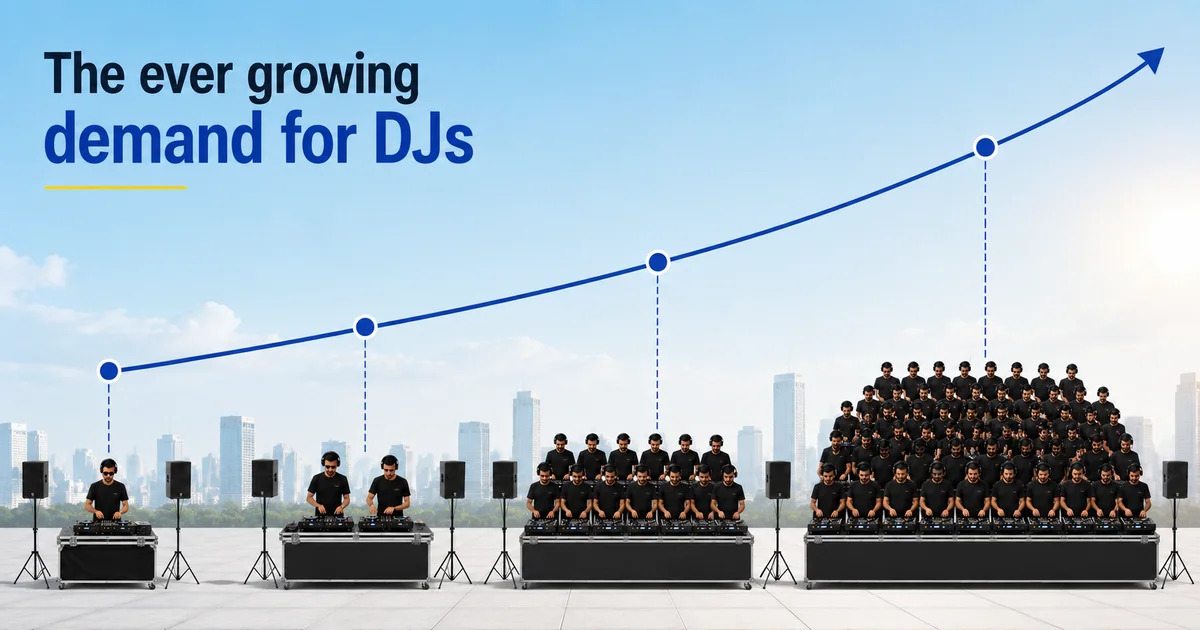
One society Holi becomes seven tower parties. That’s most of this article in a sentence.
Same building, same people, same day. Two years ago the whole society threw one party and booked one DJ. Now Tower A does its own, Tower C does its own because they didn’t like last year’s, and suddenly there are six or seven parties where there used to be one.
Nobody moved in. Nobody got richer. There are just more parties — and every one of them needs somebody to play music.
That’s the thing people miss when they say “DJ demand is booming because India is young and nightlife is growing.” That sentence could be about anything. This one is specific, and it explains something the general version can’t: why there’s more DJ work even in years when clubs are shutting down.
The short version — Parties keep splitting into smaller parties. Every split is a new booking. — Ticketing apps made small paid events possible where they weren’t before. BookMyShow’s parent made a record ₹192 crore profit in FY2025 off live events. Zomato’s District is now fighting them for it. — Bars want DJs because the bar pays for everything, and music keeps the room full. — Hotels are building more places with dance floors. Taj’s parent has 645 hotels with 263 more coming. The Park runs 81 restaurants, clubs and bars. — Enquiries to our own academy have roughly doubled year on year. — The bad news: more bookings means more nights out, and it’s crowded at the entry level.
1. The party keeps splitting
Watch any growing suburb and you’ll see it.
A society throws one Holi party. One committee, everyone chips in, one DJ. Two years later each tower has its own committee, its own WhatsApp group, and its own strong opinions about what the party should cost and what music should play. So Tower A does its own. Then Tower C decides they can do it better. Within a few seasons that one party has become five or six, all on the same day, in the same compound, for the same people.
More parties. Same number of people. And it doesn’t go backwards — once Tower C has thrown its own Holi, it’s never going back to sharing one with Tower A.
This is happening everywhere, not just in housing societies:
| Used to be one thing | Now it’s |
|---|---|
| Society Holi or Diwali | Each tower doing its own, same day |
| Wedding: reception, maybe one music night | Sangeet, haldi, mehendi, cocktail, reception |
| Company annual day | Offsites every quarter, team dinners, launches |
| ”Going out” meant a club | Café brunches, gyms, gaming lounges, resto-bars |
And look at what builders are putting up. Every new gated project has a clubhouse, a party lawn, a community hall residents can book. Those are venues. Builders are basically constructing party spaces at scale without thinking of them that way.
We’ve been watching this from the booking side since 2011, across our branches in Mumbai, Thane, Kolkata, Bengaluru and Guwahati. You won’t find it in an industry report — but you’ll see it in any society that’s split its Holi.
2. The apps made small gigs possible
The house-party side split on its own. The paid-event side got built on purpose.
Before ticketing apps, putting on a 400-person paid show in a smaller city was close to impossible. Nobody knew it was happening, you took cash at the gate, and if nobody showed up the promoter ate the whole loss. The apps fixed that. Somebody in Indore can now put a show up, sell tickets and know their numbers before the day, all from a phone.
And it clearly worked. BookMyShow’s parent company reported a record ₹192 crore profit in FY2025, which it attributed to its live events business. Then Zomato launched District and started chasing the same market. Two well-funded companies competing to create events is a very different thing from one company selling tickets to events that would have happened anyway.
Sponsors push it further. Liquor brands can’t advertise their products directly in India. Energy drinks, headphone brands, payment apps and cab companies all want to reach young people in cities. A DJ night is the cheapest and easiest thing to sponsor — no big artist demands, no seated venue, no long approval process. Brands need a certain number of these every quarter, so in practice they don’t just fund these nights, they cause them to happen.
Worth flipping something around here. People assume kids see festival reels and decide to become DJs. It’s the other way round: the gigs showed up first, and the interest followed. A kid in Nagpur wants to DJ because there are now actual paid DJ nights in Nagpur that he can go to, and eventually play.
Worth keeping in proportion: India’s live events market is quoted at around ₹13,000 crore growing 19% a year, but that figure is mostly stadium concerts and arena tours — Coldplay and Diljit, not your society Holi. It shows the machinery around live events is growing and well funded. The small-gig market is a different thing, and it’s growing for its own reasons.
3. Why it’s the DJ who gets the work
For years, live bands played private events. Now it’s mostly DJs. It’s easy to call that a change in taste. It isn’t really.
It’s about how small a job can get before it stops making sense.
A band needs a stage, six or eight people, a soundcheck, and enough money to make it worth everyone’s evening. A DJ needs a table and a couple of hours’ notice, and works just as well for forty people on a terrace as for four thousand at a festival.
So when parties get smaller and more frequent, the band stops fitting. Not because anyone dislikes bands — a six-piece band at a single tower’s Holi just doesn’t add up. The DJ is the one who can follow the work down to that size.
Worth being clear about comedy, since people lump it in: stand-up isn’t losing to DJs. It’s one of the fastest-growing live categories in India — Zakir Khan has reportedly toured 45 cities. It’s growing in its own direction, towards rooms where people sit down and listen. The two aren’t competing for the same booking.
4. Why people keep opening places that need a DJ
Nobody opens a club because they love nightlife. They open it because the money works — and often because there’s a property play underneath it.
The bar is where the money is. In any licensed venue, beverages carry far higher margins than food — which is why the bar, not the kitchen, usually decides whether a place survives. And that’s exactly where the DJ fits in: music keeps people in the room, and a full room keeps ordering. A quiet restaurant wants your table back. A venue with a DJ wants you to stay another two hours.
The Park hotels group — 81 restaurants, clubs and bars — says in its own investor documents that its nightclub business boosts liquor and wine revenue. That’s a listed company explaining the exact same thing about its own accounts.
(Figures like “70–80% margin on drinks vs 30–40% on food” get quoted a lot — those are global hospitality benchmarks rather than Indian club accounts, but the direction holds.)
The format that’s actually growing isn’t the pure nightclub — it’s the resto-bar, the rooftop, the place doing brunch with a DJ on Sunday afternoon. Money coming in during the day and at night, with the same drinks margin underneath. That’s why these keep opening in places where a straight club would be too risky. And every one of them wants music.
And there’s usually a property bet underneath. Operators often take space early in a new mall or office area, before the area fills out, and lock in a cheap long lease. The place pays its way while the location gets more valuable around it. It’s why venues keep opening even in areas where clubs keep closing — the club was never the only bet. For a DJ, what matters is the outcome: new rooms keep opening whether or not last year’s rooms survived.
Office parks are the quiet ingredient. They bring weekday business — team dinners, offsites, launch parties. That’s the difference between a place that dies in year two and a place that keeps going.
5. The hotels are building too
Independent operators are one thing. Big listed companies putting money into ten-year plans is another, and they’re pointing the same way.
Taj’s parent company (IHCL) had 645 hotels as of June 2026 — 382 open, 263 still being built — heading for 700. And they’re not just doing metros: recent signings include Vrindavan, Varanasi, Kanpur, Coorg, Udaipur, Dehradun and Lakshadweep.
The Park is the more relevant one, because nightlife is literally their thing. They run 81 restaurants, clubs and bars — Tantra, Roxy, Someplace Else, Zen, aqua — and they’re aiming for 6,635 rooms by 2030.
One caveat: a new hotel is not automatically a DJ job. Banquet halls and restaurants with music are; a budget business hotel adding rooms isn’t. The signal here is more venues where people gather — not a headcount of DJ vacancies. Rooms that need music, not rooms with beds.
6. What we see from our side
Enquiries to our academy have roughly doubled year on year. More people are walking in wanting to learn this than at any point since we started in 2011, and the growth is showing up across every branch, not one city.
That’s our own vantage point, not a market survey — but it lines up with everything above. The venues are being built, the events are multiplying, and people are noticing.
7. There aren’t many people ahead of you
Here’s the part that matters if you’re thinking about doing this.
Playback singing in India has about a hundred years of people stacked up in it. Families, gatekeepers, three generations already in the queue. Same with acting. Same with classical dance.
DJing as a real job here is about twenty years old. The scene got going in the early-to-mid 2000s, Sunburn proved money could be made, Magnetic Fields started in 2013. The people who started back then are around forty and still working. There’s no second and third generation stacked up behind them, because the job hasn’t existed long enough for that.
Here’s what that looks like in practice: DJ Roop from Kolkata was the only Indian act at Tomorrowland Belgium in 2024 — he went back in 2026 — while working as a software engineer at TCS.
One Indian on that stage, out of 1.4 billion people. And he kept his day job to get there. In singing, one Indian reaching the top of the field in a given year wouldn’t even be a story; hundreds of people are competing at that level. In DJing it’s still thin enough that one person can be the only one.
8. Now the bad news
Here’s the argument against everything above.
More parties means more nights out. A tower party pays ₹25,000–40,000, and it pays roughly that whether it’s the whole society or one tower out of seven — the fee tracks the booking, not the headcount. So when a society splits, the work multiplies at close to a flat rate. The catch is the calendar: more nights, more travelling, more setting up, more people to deal with. This suits somebody building a name and a base of regulars. It suits nobody who wants one big booking to cover the month.
And it’s crowded at the entry level. What the work pays at the top end — what an established DJ with a name can command:
| The gig | What it can pay |
|---|---|
| Society or tower party | ₹25,000–40,000 |
| Club residency | ₹1,05,000–1,20,000 a month |
| Corporate event | ₹1,50,000–2,10,000 |
| Wedding, good one | up to ₹3,00,000 |
Nobody starts there. Early gigs pay a fraction of this, and plenty of DJs never get past that stage. What separates the two isn’t talent — it’s training, reliability, and a few years of turning up and holding a floor. Club owners have also started asking for proof you can pull a crowd, not just a press kit.
So the honest version is narrower than the headline: there is more work than there used to be, and fewer people ahead of you than in most performing careers — but it’s crowded at the bottom and the money per gig is getting squeezed.
More demand doesn’t mean easy money. It means more chances to get picked, with more people trying to get picked.
So what does this add up to
More people need DJs, and it’s got nothing to do with whether EDM is in fashion this year:
- Parties keep splitting into more, smaller parties
- Ticketing apps and sponsor money made small paid gigs possible
- Bars want music because music sells drinks
- People keep opening venues for the money and the property
- The job is twenty years old competing with hundred-year-old ones
And against that: fees are getting split up along with the parties, and there are enough DJs now that experienced ones are feeling it.
The people who do well here aren’t the ones betting on a boom. They’re the ones who can actually play — reliably, for different kinds of crowds, at a tower Holi and a ticketed club night and a corporate party — because the growth is in the number of gigs and the range of them, not in one big stage.
Nikhil Talreja runs PartyMap Academy, which has been teaching DJs since 2011 in Mumbai, Thane, Kolkata, Bengaluru and Guwahati — including DJ Roop, the only Indian act at Tomorrowland Belgium 2024. The stuff about parties splitting up comes from fifteen years of watching bookings change. See the DJ course →
Sources
- IHCL — growth update, H1 FY2026
- IHCL — portfolio and pipeline
- Apeejay Surrendra Park Hotels — analyst report covering F&B, nightclubs and liquor revenue
- The Park Hotels — brands and outlets
- Hollywood Reporter India — India’s concert boom, with EY-Parthenon / BookMyShow market figures
- The Established — how the Indian DJ scene got here
- Filmibeat — DJ Roop at Tomorrowland Belgium 2024