
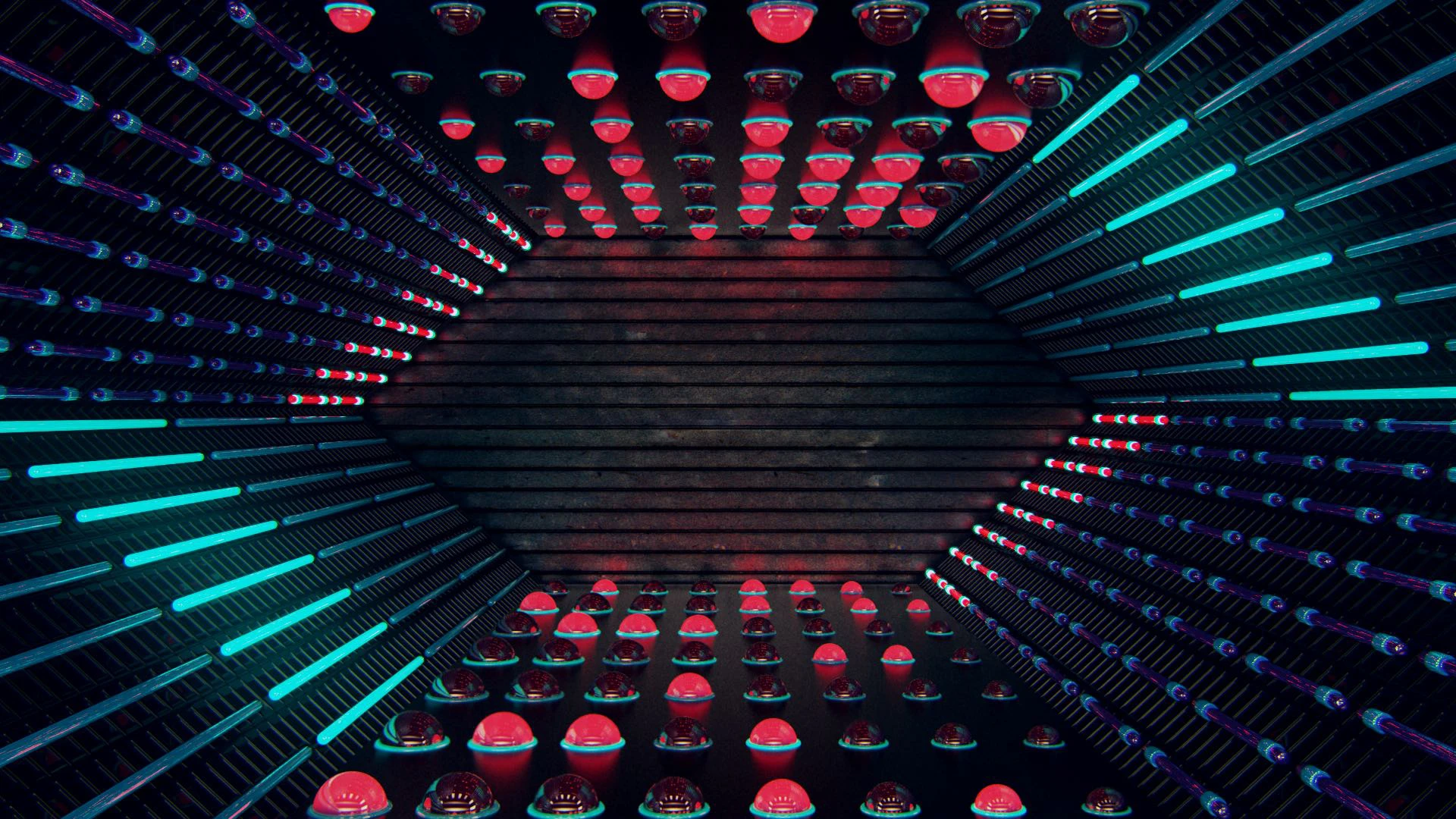
You’ve been to a festival. The DJ drops a beat and the stage erupts — not just with sound, but with synchronized visuals that pulse, morph, and react to every kick drum. Someone made that happen in real time. That person is a VJ.
VJ-ing (visual jockeying) is one of the most misunderstood creative roles in live entertainment. It’s not video editing. It’s not graphic design. It’s live performance — improvised, reactive, and deeply tied to music. This article explains what VJs actually do, why Resolume Arena is the tool of choice, and what a structured course teaches you.
Key Takeaways
- VJs mix video clips and generative visuals live, synchronized to music — similar to how a DJ mixes audio tracks
- Resolume Arena holds an estimated 70-80% market share among professional VJs (Resolume user community surveys, 2022)
- Career paths include club residencies, festival production teams, corporate events, and theatre
- You can start with a decent laptop and a Resolume license — no dedicated hardware required
- PartyMap Academy’s VJ course is available in Mumbai, Kolkata, and online from anywhere in India
What Does a VJ Actually Do?
A VJ manages real-time video performance during live events. According to the International VJ Association, the role emerged from 1980s club culture and now spans clubs, concerts, corporate events, and large-scale festivals (IVJA, 2021). The job is not about playing a pre-rendered video — it’s about reading the room, responding to the music, and making split-second creative decisions on stage.
[IMAGE: VJ performing at a festival stage behind a laptop, colorful visuals projected on LED wall — search terms: “VJ festival stage visual performance”]
Think of a DJ set. The DJ doesn’t play a single pre-mixed track from start to finish — they blend, cut, layer, and react. A VJ does exactly that, but with video. You’re organizing clips into a deck, triggering them live, applying real-time effects, and syncing everything to the BPM of whatever the DJ is playing.
What separates a good VJ from a mediocre one is improvisation. You can’t fully plan a two-hour set because the music will surprise you. A skilled VJ has enough clips organized and enough technical fluency that they can respond instantly — matching an unexpected breakdown with abstract generative visuals, or switching from neon geometry to raw footage when the crowd energy shifts.
Why Resolume Arena Is the Industry Standard
Resolume Arena is the software VJs worldwide reach for first. It holds an estimated 70-80% share among professional VJs, according to community surveys on the Resolume user forum (Resolume community, 2022). That dominance exists for good reasons.
[CHART: Bar chart - Software used by professional VJs: Resolume Arena ~75%, VDMX ~12%, Modul8 ~8%, Other ~5% - Source: Resolume community surveys 2022]
Regular video editing software — Premiere Pro, DaVinci Resolve, Final Cut — works with a timeline. You build a sequence, render it, export it. Resolume works with a deck: a grid of clips you can trigger, layer, and manipulate in real time. There’s no rendering delay. Every change is immediate.
Resolume’s key strengths for live performance include its BPM sync engine, which detects tempo from audio input and locks visual transitions to the beat automatically. Its effects chain is non-destructive, meaning you can stack color grading, blur, distortion, and strobe effects on any clip without permanently altering the source file. For festival-scale shows, Arena includes advanced output mapping — you can split your visual feed across multiple projectors, LED panels, or irregular surfaces with pixel-level precision.
[PERSONAL EXPERIENCE]: Students who come from a video editing background consistently find the mental shift the hardest part. Resolume’s logic is more like a DJ mixer than a timeline editor. Once that clicks, progress accelerates fast.
What You Learn in a Resolume VJ Course
A well-structured VJ course moves from software fundamentals into live performance technique. Here’s the skill progression you’d follow at PartyMap Academy:
Clip Management and Deck Building
Before you perform, you need organized material. You’ll learn how to source, prepare, and encode video clips for optimal playback performance. Resolume works best with specific codecs (HAP and DXV are the go-to formats for GPU-accelerated playback). Getting your clip library right from the start prevents frame drops and stuttering during live sets.
Live Mixing and BPM Sync
The core skill. You learn to trigger clips in time with music, use Resolume’s auto-BPM detection, and set clip loop points that feel musical rather than mechanical. You’ll practice live mixing with actual DJ sets — matching visual energy to sonic energy in real time.
MIDI Mapping and Hardware Control
Most professional VJs don’t mouse-click their way through a show. You’ll learn to map Resolume’s controls to a MIDI controller — a hardware device with faders, knobs, and pads that lets you perform physically rather than clicking through menus. This is the difference between watching a screen and performing.
Generative Visuals and Effects
Resolume includes a built-in synthesizer called Avenue that generates visuals algorithmically from audio input. You’ll work with these alongside pre-rendered clips, learning when generative content serves the moment better than footage.
Projection Mapping Basics
Arena’s output section includes a basic projection mapper. You’ll learn how to map visuals onto non-flat surfaces — a skill that opens doors to installation work, theatrical productions, and architectural projections.
[IMAGE: Resolume Arena software interface showing clip deck and mixer — search terms: “Resolume Arena software interface VJ”]
Is VJ-ing a Real Career?
Yes, and it’s more varied than most people expect. The global live events industry was valued at $1.1 trillion in 2023 and is projected to grow at 5.7% annually through 2030 (Allied Market Research, 2023). VJs work across several distinct contexts:
Club residencies are the most consistent source of income for VJs in India’s metro cities. Mumbai, Delhi, and Bengaluru all have clubs that maintain in-house or contracted VJ setups.
Festival production teams hire VJs as part of larger stage design crews. Sunburn, NH7 Weekender, and similar events in India employ dedicated visual teams who work alongside lighting designers and stage managers.
Corporate events are a fast-growing segment. Product launches, brand activations, and award shows increasingly use real-time visual performance rather than pre-rendered loops. Corporate rates are typically higher than club rates.
Theatre and installation art offer a different trajectory — slower-paced, more conceptual, but with strong creative freedom and opportunities to exhibit internationally.
[UNIQUE INSIGHT]: India’s VJ market is at an early stage compared to Europe, which means Indian VJs who develop skills now face less competition and more room to define their rates and positioning. The infrastructure (LED walls, multi-projector setups) is reaching tier-2 cities faster than the trained VJ talent is.
How the Online Course Works
Learning live performance online sounds like a contradiction. It’s actually more practical than it seems.
PartyMap Academy’s VJ course has been running since 2011, with in-person batches in Mumbai (Andheri) and Kolkata, and an online track for students anywhere in India.
Online sessions use screen sharing to demonstrate Resolume in real time. Students follow along on their own Resolume installation. Assignments are performance-based: you record yourself doing a live mix against a provided DJ set, then get feedback on clip selection, timing accuracy, and effect choices. The feedback loop is the same as in-person — the difference is you’re building your home setup from day one, which is the setup you’ll actually use for paid gigs.
What Gear Do You Need?
The barrier to entry is lower than most people assume. You need:
- A laptop with a dedicated GPU (Nvidia or AMD) and at least 8GB RAM — a gaming laptop in the mid-range works fine
- A Resolume Arena license (current price: around $350-400 USD for a perpetual license, with a free trial available)
- A MIDI controller — entry-level options from Akai or Novation start around Rs. 5,000-8,000
You don’t need a dedicated VJ workstation or external hardware to start. Most students begin with exactly what they have and upgrade as they take on paid work.
The Honest Difference Between This and Design School
Graphic designers and video editors create work that gets viewed later. A VJ creates work that happens once, live, in the room. There’s no undo. No revision. No client approval cycle.
That’s terrifying for some people. For others, it’s the whole point.
If you’ve ever watched a live set and felt that the visuals were locked to the music in a way that felt alive rather than canned, you’ve seen skilled VJ work. That responsiveness doesn’t come from a rendered file — it comes from a person with trained instincts, good clip organization, and enough Resolume fluency to make decisions faster than conscious thought.
That’s what the course builds. The software is learnable in weeks. The performance instincts take months of practice. Starting now is the only way to compress that timeline.
Explore the full VJ course details and upcoming batches at PartyMap Academy. In-person batches run in Mumbai and Kolkata; the online track is open to students across India.